Last month, Niki and Anna were at Craigroyston high school for a few weeks helping out with their Mega May expressive arts take over during the exam period!
“We had some brilliant groups creating their own fantasy bands, planning concerts, designing logos, posters, and fliers, and a crash course in songwriting too!”- Anna (Tinderbox Tutor and Artist).
We look forward to more sessions at Craigroyston in the future!
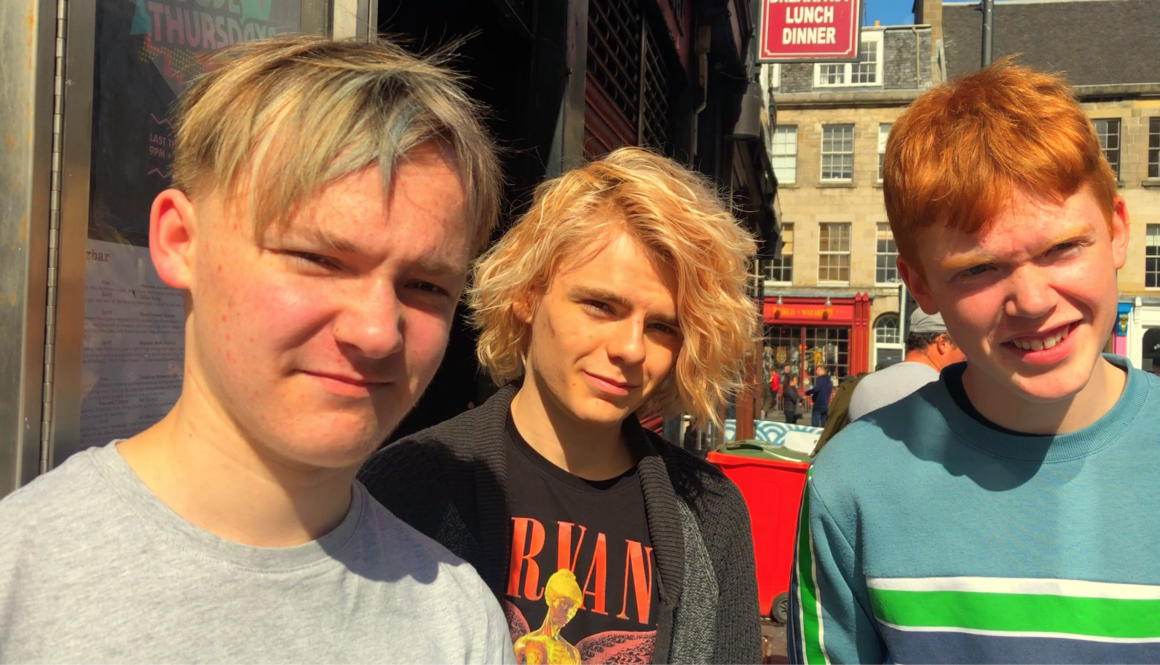
It was an inspirational rehearsal at the Jazz Bar on Sunday. We had collaborators in the form on the young and brilliant ’Three out of Four’ (pictured) from the Borders playing their song, Night to remember (https://youtu.be/GCuPp1a9oSA).
Also the exuberant and joyful ‘ACE Voices’ visiting from Aberdeen. And of course the sublime talent of Hailey Beavis. Things are really hotting up ready for the gig on 16th June at the Jazz Bar!
“If you haven’t made it to Mac art in Galashiels yet, then this Friday is the time to do it! The doors of this stunning converted church have been open each Wednesday night for the past 6 weeks to give a space for young people living across the Scottish Borders to come together and get creative.
James McIntosh of Sound Cycle, the Scottish Borders youth music forum, has hosted Niki , Rab and Jed from Tinderbox coming down to collaborate with the young people on writing arranging orchestrating and building up to performing some exciting new music ( as well as the challenge of seeing how many gig posters we can get up on route from Edinburgh to Galashiels!).
Niki has been heading up the project with her highlight being young composer and orchestrator Rab Taylor from Tinderbox collaborating with band 3 out of 4 to add the power of the Tinderbox Orchestra to a song they finished writing after week 1 of us all meeting. the track is called a night to remember and it definitely will be so hope to see you at Mac arts Friday 7th June from 7-10pm!”
We were delighted when we received all these thank you cards from Granton Primary school children who attended our music workshops! There was over 30 cards with amazingly creative drawings and messages inside. Thank you Granton Primary!
“After each music session at The Sick Kids Hospital, I offer the children and young people the chance to draw on my guitar. Quite often they will draw something relating to what we have been singing about, so the guitar tells the story of all the songs we have written and sung. Everything from exotic holidays to rainbow unicorns and tigers adorn the instrument. It is a journey into the imaginative worlds of the children and young people who have visited the hospital.
Edinburgh Children’s Hospital Charity recently invited me to paint an Oor Wullie, for part of The Bucket Trail, and I decided to reproduce as many of the children’s drawing as possible onto his dungarees, so he can tell the stories to other children who see him, and share the adventures we have had.
My guitar is so full of drawings now that there is no space left. It’s time to paint it white and start again. And by passing all the drawings on to Oor Wullie, it means they will not be lost! Oor Wullie will be revealed soon… watch this space for updates on his new multi coloured dungarees! For now, here is a pic of the awesome hospital guitar!” – Hailey, Tinderbox Artist.
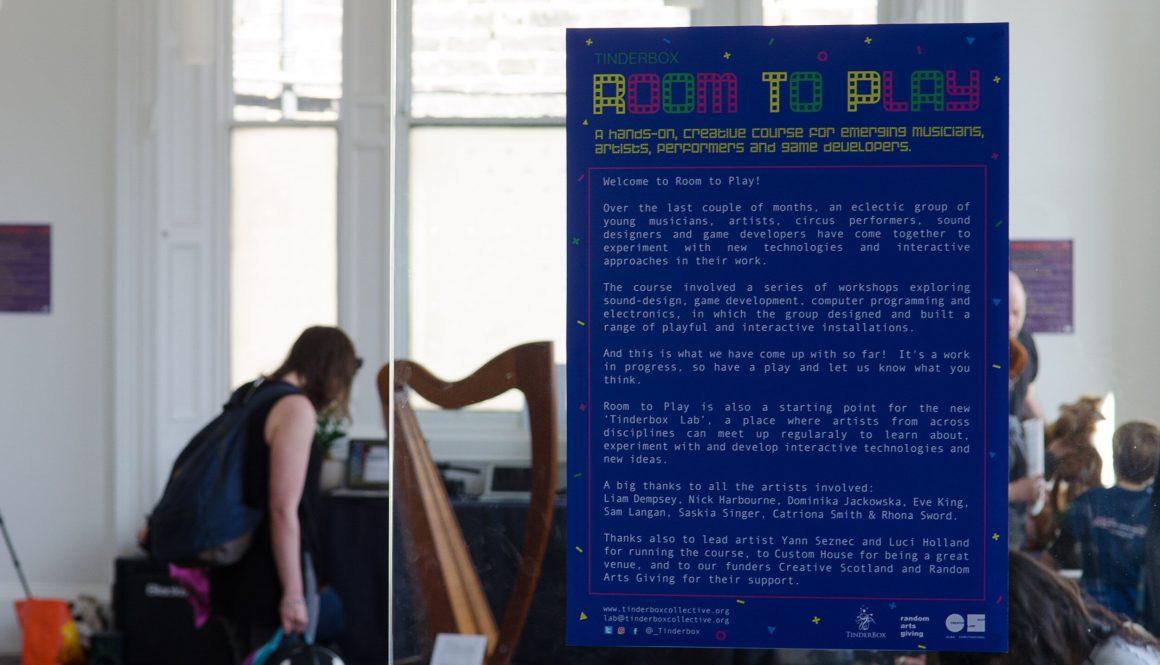
“Exhibition, collaboration and improvisation filled the halls of Custom House for the Room to Play showcase. This year’s cohort displayed a series of innovative and interactive installations with typical Room to Play eclecticism! Visitor spent the morning and early afternoon engaging with the individual works. From Nick Harbourne’s sometimes delicate, sometimes booming, feedback system which mixed sculpture with sound-world; to Eve King and Rhona Sword’s interactive visuals and soundscape; and Dominika Jackowska’s Rorschach paintings-come-light filters which upon viewing magically altered the accompanying soundscape. Later, stuffed toys refitted with accelerometers that detect movement and playback sound- joyous and playful inventions that had entertained and engaged all ages, by Liam Dempsey- featured as solo instruments, played by the audience, in a collaborative performance with the Tinderbox Orchestra. The same treatment was given to the light controlled instrument by Catriona Smith, made out of a recycled harp frame. The artists did an amazing job engaging creatively with the technologies they had come across, often for the first time, in the Room to Play course. The results were a polished and professional showcase that offered something inspiring and playful to the people of Leith.” –Martin Disley, Room to Play Artist.
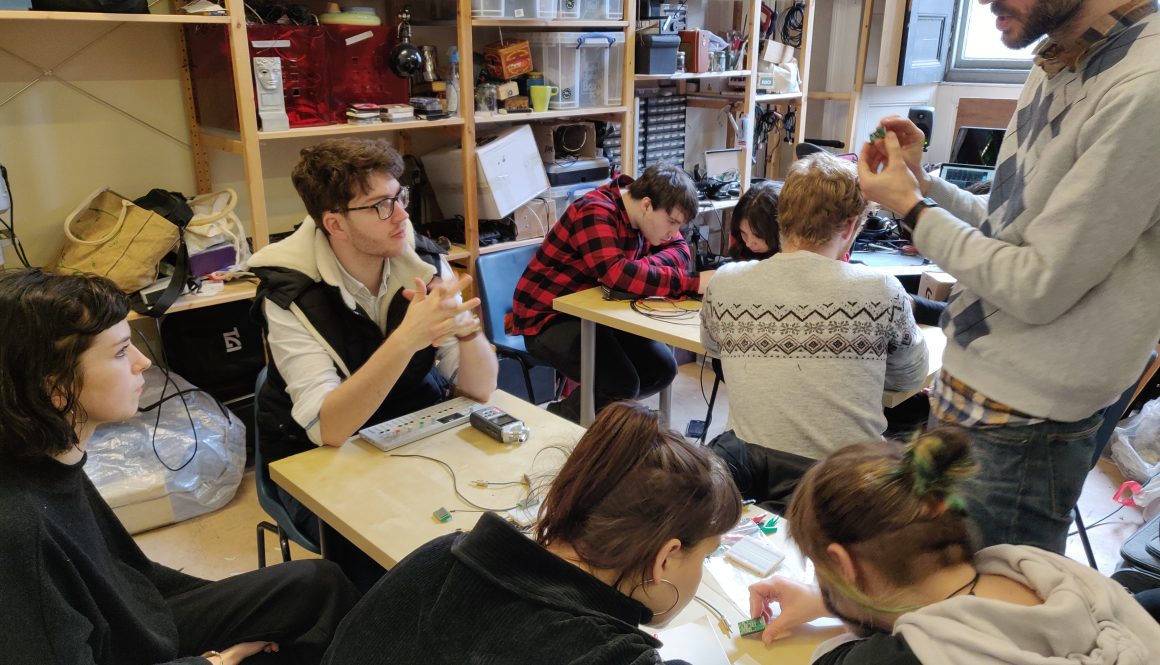
“Had a great time at my first Tinderbox Lab today! For a while I have been wanting to experiment with audio reactive lighting using MAX/msp and Teensy boards. I came in with a vague idea of what this might entail, but as a sound artist with little experience, I did not have a clue of how to approach this. With Luci’s help, I was able to learn the basics of electronics and Arduino coding and finally put my ideas into practice. The lab’s resources make it possible for everyone to work on various projects and explore creative ideas together. I’m looking forward to also attend some Wednesday lab sessions as well as the Saturday drop ins!” – Sonia, Tinderbox Musician and Digital Artist.
“We had a great session today at our first Saturday Lab, with lots of mini electronics and coding projects and also a visit from games designers Kirsty Keatch and Florian Veltman from London games studio ustwo games!”- Luci, Tinderbox Musician and Digital Artist.
“We had lots of fun with the Tinderbox team at Granton Primary School before the easter break and got a big surprise in the form of lots of thank you cards when we went back in today!
We are excited to be offering a new music hub on Thursdays 5 to 7 p.m. at Granton Youth Club from the 27th April – 27th June!” – Niki.
What a great term we had working with Granton and Ferryhill Primary Schools. They nailed it at the concert. Looking forward to seeing some of the gang back for Tinderbox Sparks starting on Sunday morning!
“Have you ever wondered what it was like to see the world through a bat’s eyes? Mostly darkness and misty shapes, rather akin to me sans glasses. A rather better question is: What does it mean to hear the world like a bat?
Working with the mildly baffling and eternally frightening
software that is Pure Data* (PD), this week’s Room to Play focused on
programming an ultrasonic sensor to do our musical bidding. The sensor is
plugged into a breadboard into which a Teensy board is slotted, providing the
link between computer and hardware. In order to hear what it’s outputting, you
must then turn to software to interpret the data. Max MSP does the job
absolutely fine, and I’m pretty sure if you worked hard enough any software
would work, even Audacity, though I shudder at the thought. The wonderful thing
about PD is that is it a free, flexible piece of software which apes much of
Max MSP’s workflow with rather less hand-holding, being perfect for myriad
purposes including the one we’ll be using it for today.
Transforming the data from the sensor into something usable
in PD takes a small while to figure out. Scaling issues, Arduino code
confusion, and incorrectly constructed breadboards are among the problems (note
how there’s always one common factor: myself). However it’s very easy to use to
quickly alter parameters such as sample start and end times. This is the first
step towards a controllable granular synthesiser, which is precisely what I
failed to create in the session. Rapidly retriggering a recorded sample allows
you to work within miniscule time scales, something that’s great for
granulation – though hard on the ears. The challenge is working out effective
enveloping in order to reduce zero-point crossing, why you get unpleasant
glitches, and then how to make sure those envelopes don’t get totally mangled
in the process.
All of these challenges aside, it’s mildly amusing and
vaguely effective to simply programme the data in order to trigger random
parameters for an aleatoric outcome and then ‘perform’ it, similarly to how one
would perform a theremin. Cue several minutes of hand waving and general
wizardy-looking performance.
One of the issues in using an ultrasonic sensor is that the
data isn’t very pure. Because of the way the sensor works – emitting a sound
from a speaker, recording the reverberation from a surface with a microphone,
and then calculating the distant based on travel time – you end up with a lot
of interference from different surfaces. Therefore, its use should be very
carefully thought out, or used for something that doesn’t care about inaccurate
data. However, when building an unpredictable and quite frankly crazy sounding
PD patch, I don’t think the accuracy of data really matters all that much in
the grand scheme of things. Somehow, being wrong only makes it feel more right.
Except when it stops working
entirely, at which point you throw the entire system out of the window.
As a continuation of our exploration in working with different types of sensors, the ultrasonic sensor ended up being interesting but a little hard to make work predictably. As a tool to create controlled chaos it was certainly effective. The important question though is, did we end up hearing what a bat hears? I certainly hope not, lest I mourn for the unfortunate fate of our local bat population, periodically flying into nearby chimneys at the behest of their faulty sensors. “
*Colloquially known as
What-Is-That-Why-Is-It-Beeping-Oh-God-I-Think-It’s-On-Fire Data, or the catchy
WITWIIBOGITIOFD.
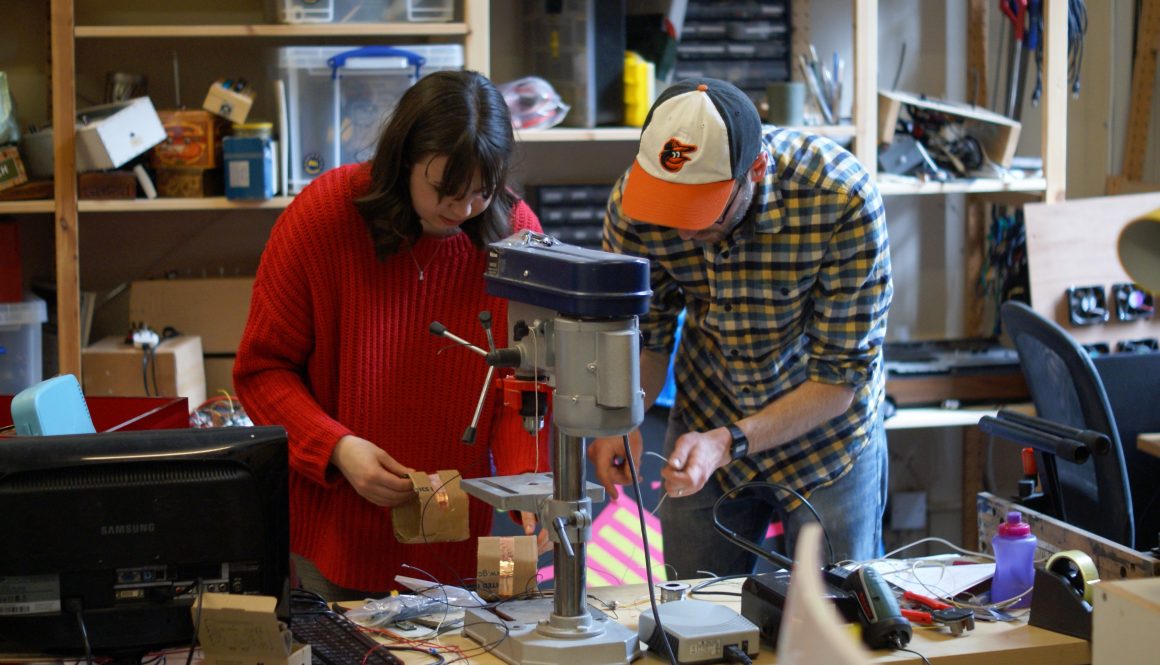
“On the morning of week 3 we were split into pairs and each pair was given a different type of microphone. We were then given 30 minutes to gather field recordings which could be looped. After lunch we built mini synthesisers in pairs, which we hooked up to light sensors. We experimented with different ways of manipulating the light and therefore manipulating the sound. As someone who has minimal experience in electrical engineering, this was a very rewarding exercise as I had never done anything like this before and was surprised at how easy it was to do. Yann gave great step by step instructions and offered assistance when ever it was needed. _ Week 4 started with an activity which had been developed by the previous RoomTo Play students. We used copper tape and wires to turn trampolines into massive buttons and recorded sounds for them to make when jumped on. We then took turns jumping and creating beats. During this session we began to explore ideas for our individual projects, with much help and encouragement from Yann and Luci. They offered great suggestions for the development of my idea and showed me how to use appropriate programmes such as Max. We also made midi controllers which we controlled with touch sensors and light sensors.This activity involved coding which was a great introduction to coding for those who did not have previous experience. _ On the morning of week 5, Yann asked us to write short plans for our personal projects. We then each shared our ideas to the group, brain storming together.This was a great way of developing the project ideas and was really helpful to hear the expertise of the other group members. After this we focused on learning how to use the programme Pure Data. Using Pure Data, we made a synth and a sound player. Every one got quite sucked into this and there was a great symphony of bleeps and bloops coming from everyone’s laptops for most of the day.” -Eve King (Room To Play Artist).
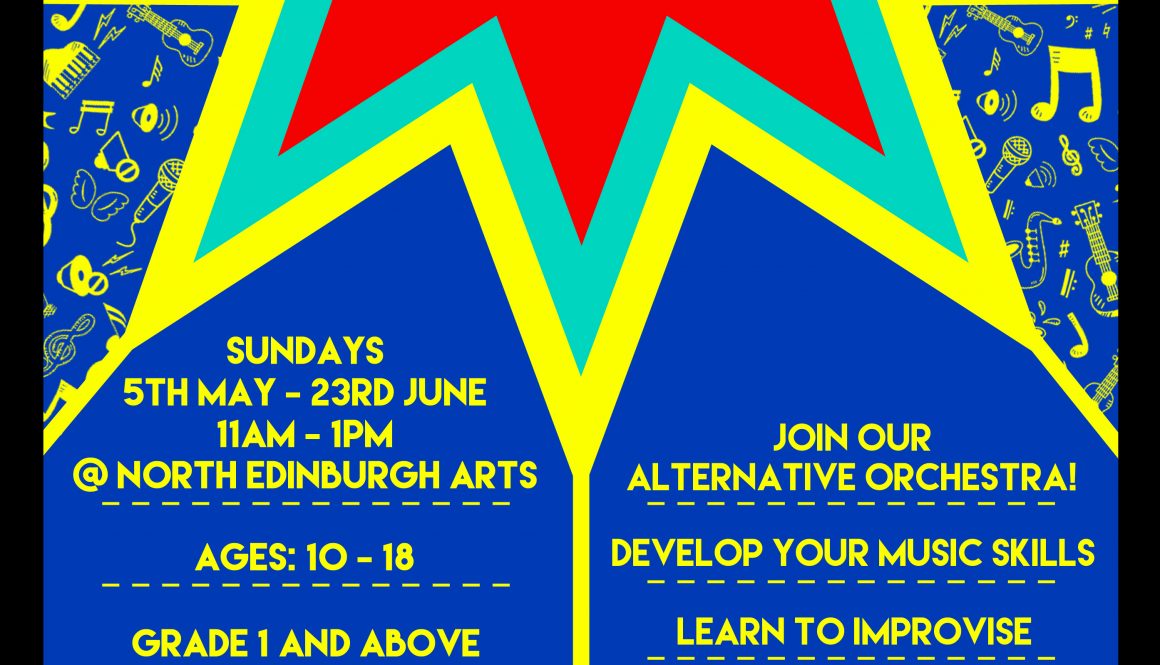
Applications are open for Tinderbox Sparks our entry level Alternative Orchestra course for 10 – 18 year olds. Grade 1 (or equivalent ability) upwards. Improvise, Compose and perform.
Join Edinburgh’s Alternative Orchestra!
Sundays 11am – 1pm. at North Edinburgh Arts.
5th May – 23rd June
Course fee £100 (subsidised places available).
Send us a message or email to book a place admin@tinderboxcollective.org.
We will be working with the amazing Mike Kearney and members of the Tinderbox Orchestra to learn some new compositions that have been written this year by the Tinderbox Collective. We will explore the world of improvisation using a kung fu based conducting technique called ‘Suggesture’. We’ll compose a brand new piece of music.
The course will culminate in a performance alongside the Tinderbox Orchestra and our other projects, Tuesday Hub, Rock Trust Hub and Digital Lab.
Applications are open for Tinderbox Sparks our entry level Alternative Orchestra course for 10 – 18 year olds. Grade 1 (or equivalent ability) upwards. Improvise, Compose and perform.
Join Edinburgh’s Alternative Orchestra.
Sundays 11am – 1pm. at North Edinburgh Arts.
5th May – 21st June.
Course fee £100 (subsidised places available).
Send us a message or email to book a place admin@tinderboxcollective.org.
We will be working with the amazing Mike Kearney and members of the Tinderbox Orchestra to learn some new compositions that have been written this year by the Tinderbox Collective. We will explore the world of improvisation using a kung fu based conducting technique called ‘Suggesture’. We’ll compose a brand new piece of music.
“After starting the room the play sessions the week before, I was really excited to go back to Custom House now that I felt settled in and completely at ease with everyone. Working with the loveliest and most enthusiastic, inspiring group of people is really helping me to find the motivation to make stuff and it was brilliant to immediately get stuck in and not feel shy about it.
This week Yann focussed more on sound and we started off the day doing some group work based on conceptual works by composers such as John Cage. Our group ended up creating a piece where everyone listened to a 4:33 recording of the inside of a bathroom whilst staring at the Water of Leith. Though a very strange experience, it really helped me to open up and find the confidence to try stuff out, regardless of whether or not I knew it would work.
The afternoon however is when I really got into it and got excited about making. Despite the fact the it’s possibly one of the fiddliest tasks I think I’ve ever done, learning how to make cassette tape loops was the most fun I’ve had in ages. Odd as it sounds, it’s a very addictive process! Everyone got really interesting results and a big though lot of the time they didn’t work, it was always the experiments and the times when things did go wrong that people got the most exciting sounds happening. Even when we tried to build an installation from it and it didn’t exactly go to plan, the unexpected results just left me wanting to make more.
As someone coming from a visual arts background I’ve never really tried, or felt like I was able to have the confidence, to work with sound, and I’ve certainly never known how to approach the technicalities of disrupting and distorting sounds. Learning this week how easy it was to do with charity shop cassette tapes and cheap Walkmans just made me want to go home and keep trying and experimenting and seeing what would happen. My work in the studio at the minute is playing around with the abstraction and distortion of information and I’m really motivated to take the skills I learnt and ideas inspired by everyone in the group back to my own work and see what happens. I was also really lucky this week that the experimental process didn’t stop for me with the Room to Play workshop as I was also able to attend the Tinderbox Orchestra Session on Sunday and I can’t recommend it highly enough to anyone that plays an instrument and just wants to have fun with it. I’ve always played the violin, and whilst I’ll always love the sorts of classical orchestras I grew up playing in, I’d become slightly tired of the sameness of amateur symphony orchestras and I was looking for an opportunity to fall in love with playing again and this was the most incredible experience to achieve that. I continued learning skills, here in improvisation and new types of music, and it kept up my excitement for trying new stuff out, giving things a go and not being so scared. It was the most amazing thing to just hear an orchestra listening to each other and everyone working together and that Sunday afternoon session has kept a smile on my face all week”.
“The first week of the Room to Play project was a very exciting and engaging session with an eclectic group of artistically inclined people, each with a uniquely keen interest into the potentially eccentric work ahead.
We spent the first portion of our day taking the phrase “room to play” quite literally. An afternoon was spent experimenting with collections of toys and board games in an attempt to understand what defines games. After some thought, it seemed as if the most common answer was rules. By establishing rules upon toys, we can turn them into games. By understanding the rules of a game, we can bend them; make a game more than it is. It seems simple (perhaps it was) but the core idea behind it seemed to be to encourage us to think differently. If we challenge the norms of games such as Twister or Dominoes, perhaps we can create something new and exciting; if not at least original and interesting. Ultimately, it was a lot of good fun and a great way to get to know the team we were working with.
After lunch we gathered again within the studio. Yann pulled out a laptop, set up a projector, and a unicorn illuminated the wall — wonderful. The unicorn was the main character of the video game CLOP, where the main objective was to get the unicorn from one end of the track to the other using four buttons that control each leg independently. The game is primarily intended for one player but by using four giant controllers, each with one big button on them, the game became a more collaborative process. Therefore the group playing had to create a shared sense of rhythm in order to complete the game.
We ended the afternoon by making our own little controllers with a mix of buttons and copper tape, which we then combined together to create one giant instrument in which we each controlled a separate pitch. In the multiplayer version of CLOP, if the players don’t communicate then the unicorn inevitably crumbles to the ground. In a similar fashion, without communicating how to play our giant collaborative instrument the sounds cluster and stumble over each other. However, by working together we could create an array of delectable melodies and a shared sense of rhythm.
I really like this idea of an exhibit that creates a sense of community around it and I’ll bear that in mind throughout the following weeks. Also as a complete novice to simple electronics, I found this to be the most rewarding aspect of the day. Already I feel a bit more confident with it all I’m feeling eager to do more with it in these sessions.”
The joy and challenge of learning music is an integral part of the lives of hundreds of thousands of young people in Scotland today. Unsurprisingly a new study has confirmed what those of us who experience this first hand already know. It has been fantastic for Tinderbox to have been part of contributing to the study and now helping to publicise its findings and promote its recommendations. If you are interested in the effect of music on young people in Scotland then have a read because this will be the defining document on the subject for the coming years!
What’s Going On Now? builds on research published in 2003, and explores the formal, informal and non-formal sectors of music education in Scotland.
We are looking for someone with a financial background to join our charity board of volunteer trustees. If you’re interested or you’d like to find out more please email admin@tinderboxcollective.org.
Tinderbox aims to ignite a spark in young people – one which fills them with confidence, imagination and a sense of possibility, and which enables people to achieve things they never thought possible. We run a range of contemporary youth orchestras, arts productions, workshops & apprenticeship schemes, bringing together young people of different ages, backgrounds, ethnicities, abilities, countries & cultures. We help break down barriers between people & communities, providing exciting opportunities to those who need them most, and supporting young people to build their confidence, skills, self-esteem, and employment prospects.
What a fantastic start to our Tinderbox Orchestra sessions at the Jazz Bar yesterday! We tried out some new music from the orchestra as well as an older piece from our album, and it was sounding brilliant! Thank you to everyone who came along and got involved, was lovely to see some new faces as well as some familiar ones too. Hope to see you all again next week for some more orchestral jams!
If you would like to come along to the sessions just pop us an email to <admin@tinderboxcollective.org> and let us know!
Applications are now open for our 8-week course for emerging musicians, game developers, visual and other artists.
Ages 18-25, Saturdays Feb 23rd to Apr 13th 2019, Custom House, Leith, Edinburgh.
The course is fully funded (free) + travel expenses covered. Applications Now Open!
Room to Play is an exciting new programme exploring interactive live and digital processes in music, art, performance and game-development.
A group of 8 emerging artists (musicians, visual artists, game developers and other disciplines), will work closely with award-winning musician, sound-designer, game developer and sonic artist, Yann Seznec (British Composer Award for Sonic Art, 2015), as well as Edinburgh’s Tinderbox Collective to learn about and develop a series of interactive, sound-based installations and performance ideas.
Course Details
Room to Play is open to artists aged 18-25.
It will run every Saturday, 11am-4pm, from Feb 23rd to Apr 13th 2019 at Custom House, Leith, Edinburgh.
Selected artists will receive a fully funded (free) place on the course including any travel expenses.
Course Description
The course is open to emerging artists of any creative medium who have an interest in developing new digital/ electronic approaches through their work. This will involve a series of workshops with Yann Seznec exploring different techniques (see below), and the artists will apply these techniques to devise, develop and build a series of interactive, sound-based installations and performance ideas throughout the course and exhibit them at the end.
There will also be the chance to bring some of the ideas and installations together with the Tinderbox Orchestra, and to develop them for workshops with other youth groups that Tinderbox works with.Workshops will likely cover the following topics:– Interactive audio– Sound installations– Soldering/building electronics– Performance design– Game design– Sound recording– Many other things!
We ran the course previously in 2016 and many of the artists have stayed in touch since. We hope it will become an ongoing programme that supports a growing and collaborative network of experimental and open-minded young artists working across disciplines.
Application Details
Deadline for applications is Wed 23rd January
To apply, please email admin@tinderboxproject.co.uk with a CV and cover note (no more than 1 side, but could be a lot shorter), describing your experience, artistic interests and why you are interested in the course.
We will aim to let you know if you have been accepted by Feb 1st.









You must be logged in to post a comment.