Room to Play: Interactive Visuals will bring together 8 emerging artists from different disciplines to experiment with and explore interactive and responsive visuals, over a 6 week course. We will learn about the technology and collaborate together to make an exciting new installation for exhibition at Hidden Door 2025. Through weekly sessions the programme will introduce & explore creative technologies (such as TouchDesigner) and interactive digital processes (for example audio-reactivity and/or camera recognition), which the selected artists will use to develop the installation.
If you are an artist or creative with an interest in creative technology, then this project may be for you!
The artist call-out for applications is open until 5pm, Fri 11th April.
Find out more and apply here – we look forward to hearing from you!
The latest Room to Play exhibition has had a couple of excellent outings over the past couple months!
A big thank you to both Hidden Door and Inspace who in June & July both hosted this amazing interactive audiovisual installation, designed by 12 artists from a range of disciplines including musicians, sound designers, visual & projection artists, filmmakers, lighting designers, and performance artists.
You can watch some films about the project here and here too!
Over several months the group came together to experiment with technology in their creative approaches to celebrate the power of play, and collaborate on a new audiovisual exhibition of playful, nature-inspired sculptures.
The installation is a playful meadow of responsive sound-making sculptures, that uses recycled and upcycled materials as the structural foundation of the work. The installation aims to evoke a sense of wonder, curiosity, and respect for the natural world, and invites us to reflect on our relationship with nature, the impact of our actions on the environment, and the urgent need to protect and preserve it.
Room to Play was designed by Abby Carter, Ink Asher Hemp, Antony Lucchesi, Jessica McIntosh, Shawn Mark Nayar, Kenneth Nuelan, Chandi Petro, Mark Sandford, Saffron Slater, Lingli Wang, Maria Cecilie Wrang-Rasmussen and Zxy Dust, with Boris Allenou and Luci Holland.
The Room to Play artists have been working tirelessly building these beautiful installations! You can visit the exhibit next at Hidden Door 2023! 31st May – 4th June
Over the last few months, the 2023 Room to Play group of musicians, sound designers, visual & projection artists, filmmakers, lighting designers, and performance artists have come together to experiment with technology in their creative approaches to celebrate the power of play, and collaborate on a new audiovisual exhibition of playful, nature-inspired sculptures.
In March the installation had its very first outing and public exhibition as part of the first floor of The Wee Hub, where the pieces were on display for people to explore and enjoy. The exhibits then made another appearance as part of our Orchestra and Dance Showcase on the ground floor of The Wee Hub, with the sound of the Room to Play sculptures kicking off a live, experimental music and dance performance piece that gradually weaved the audience into the Pianodrome venue for a concert performance with the Tinderbox Orchestra.
The installation is a gentle, playful, and beautiful meadow of responsive sound-making sculptures, that uses recycled and upcycled materials as the structural foundation of the work. It aims to evoke a sense of wonder, curiosity, and respect for the natural world, and invites us to reflect on our relationship with nature, the impact of our actions on the environment, and the urgent need to protect and preserve it.
The Room to Play exhibition is continuing to develop and will be appearing at other venues throughout the year, including Hidden Door 2023, Inspace, and Sierra Metro, so watch this space to catch it in action again!
Room to Play was designed by Abby Carter, Ink Asher Hemp, Antony Lucchesi, Jessica McIntosh, Shawn Mark Nayar, Kenneth Nuelan, Chandi Petro, Mark Sandford, Saffron Slater, Lingli Wang, Maria Cecilie Wrang-Rasmussen and Zxy Dust, with Boris Allenou and Luci Holland.
Find out more about Room to Play and the artists here:
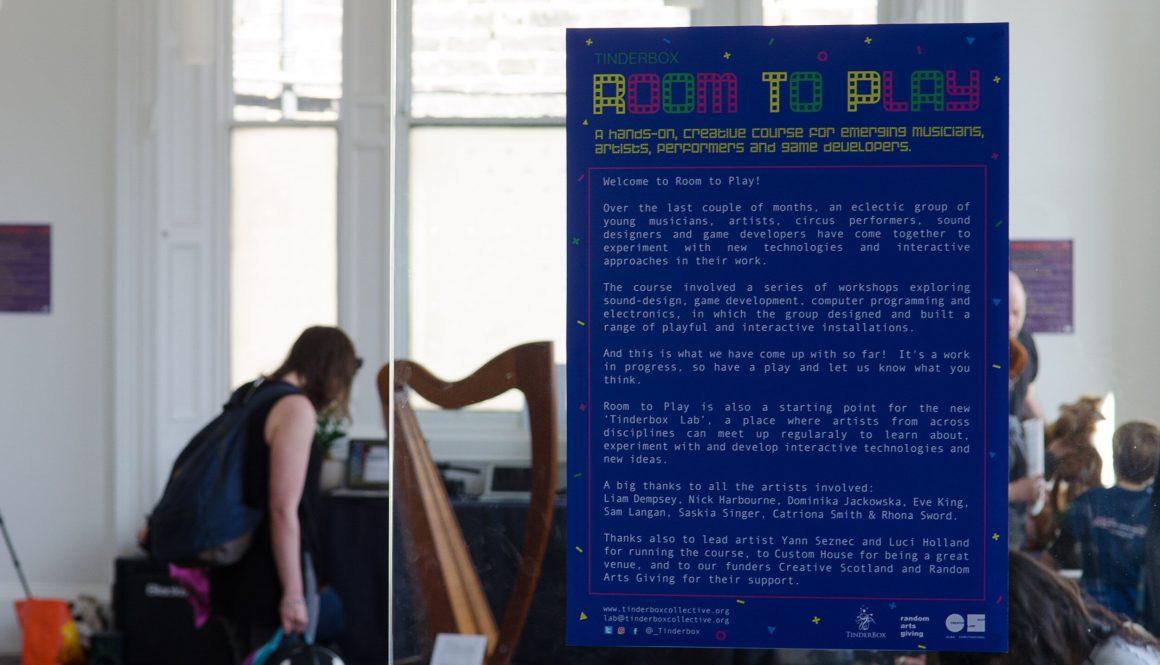
Room to Play is an annual course for emerging musicians, game developers, visual and other artists.
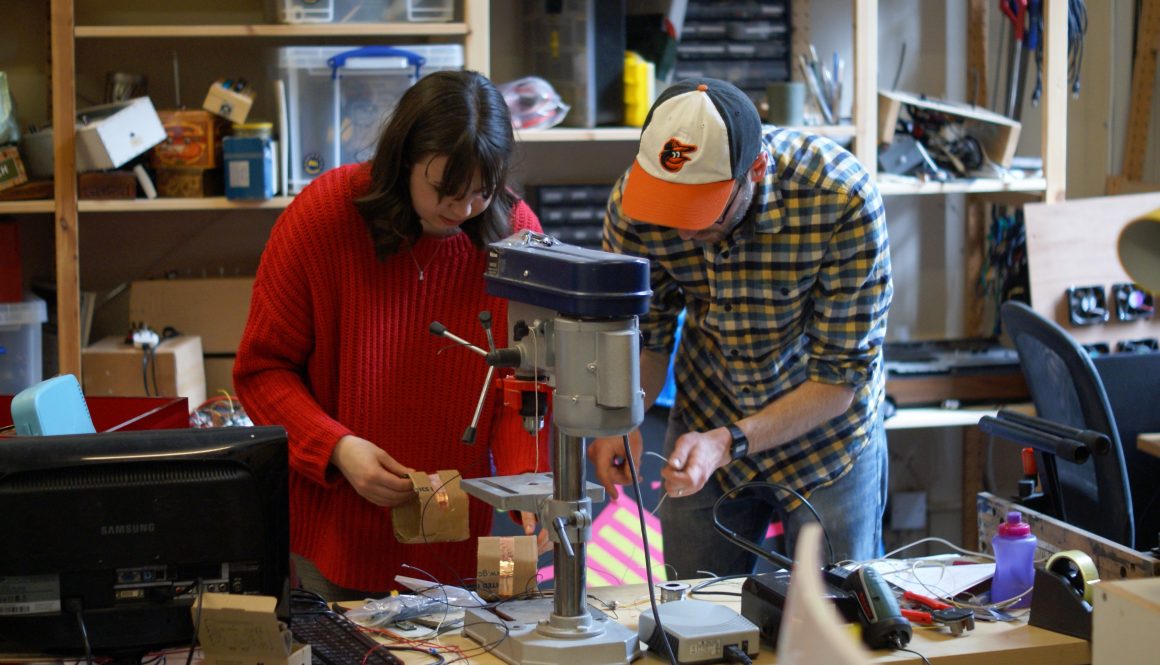
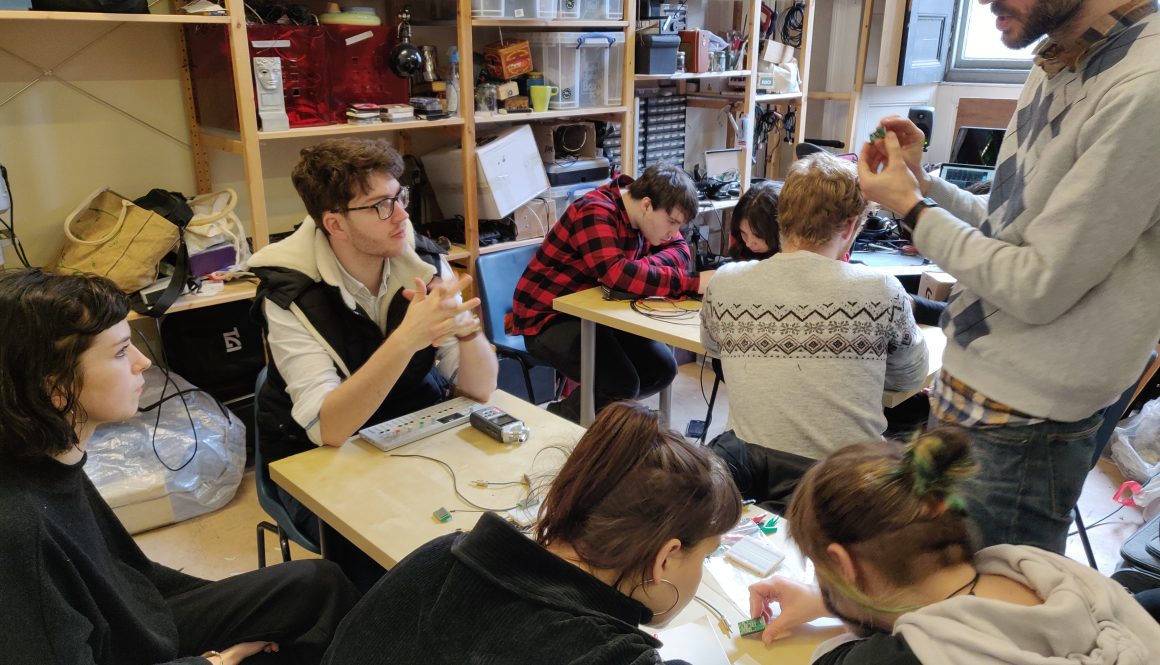
People on the programme work together over the course to develop a series of interactive installations and performance ideas. There are a range of workshops on different technologies, sound and game-design and time and support for people to develop and building their own ideas, and we pull it all together into an exciting showcase event and exhibition at the end.
There is also room for collaborating and developing ideas with Tinderbox’s other programmes including the Tinderbox Orchestra, live musicians and different youth projects.
Note: The next course has been postponed due to coronavirus
“Who knew that Teviot House’s Underground Bar was actually the perfect place for an interactive exhibition room in disguise as a nightclub?
On Saturday 22nd February 2020 Tinderbox Lab took over a cave of nooks and crannies and filled it with sonic spiderwebs, soft toys eerily reminiscent of grand pianos, orchestral illustrations and electronica trampolines. We had the most amazing time showing people around the space all day and it was so amazing and inspiring to see how inventive our guests (right down to the wee ones!) were with our pieces. It got everybody really excited to get back in the lab; playing, developing and experimenting some more!” – Rhona, Room to Play & Tinderbox Lab artist
“It was such a great experience to be able to show work created at the Room To play for The Edinburgh Festival of Sound. It was a pleasure to see everyone enjoying all the installations while having so much fun! There was definitely no a quiet moment!” Dominika Jackowska – Room to Play & Lab artist
Thanks again to The Edinburgh Festival of Sound for having us along to show our Room to Play creations off! We had to a lot of fun and were inspired by all the amazing installations and art in the exhibition!
“Exhibition, collaboration and improvisation filled the halls of Custom House for the Room to Play showcase. This year’s cohort displayed a series of innovative and interactive installations with typical Room to Play eclecticism! Visitor spent the morning and early afternoon engaging with the individual works. From Nick Harbourne’s sometimes delicate, sometimes booming, feedback system which mixed sculpture with sound-world; to Eve King and Rhona Sword’s interactive visuals and soundscape; and Dominika Jackowska’s Rorschach paintings-come-light filters which upon viewing magically altered the accompanying soundscape. Later, stuffed toys refitted with accelerometers that detect movement and playback sound- joyous and playful inventions that had entertained and engaged all ages, by Liam Dempsey- featured as solo instruments, played by the audience, in a collaborative performance with the Tinderbox Orchestra. The same treatment was given to the light controlled instrument by Catriona Smith, made out of a recycled harp frame. The artists did an amazing job engaging creatively with the technologies they had come across, often for the first time, in the Room to Play course. The results were a polished and professional showcase that offered something inspiring and playful to the people of Leith.” –Martin Disley, Room to Play Artist.
“Have you ever wondered what it was like to see the world through a bat’s eyes? Mostly darkness and misty shapes, rather akin to me sans glasses. A rather better question is: What does it mean to hear the world like a bat?
Working with the mildly baffling and eternally frightening
software that is Pure Data* (PD), this week’s Room to Play focused on
programming an ultrasonic sensor to do our musical bidding. The sensor is
plugged into a breadboard into which a Teensy board is slotted, providing the
link between computer and hardware. In order to hear what it’s outputting, you
must then turn to software to interpret the data. Max MSP does the job
absolutely fine, and I’m pretty sure if you worked hard enough any software
would work, even Audacity, though I shudder at the thought. The wonderful thing
about PD is that is it a free, flexible piece of software which apes much of
Max MSP’s workflow with rather less hand-holding, being perfect for myriad
purposes including the one we’ll be using it for today.
Transforming the data from the sensor into something usable
in PD takes a small while to figure out. Scaling issues, Arduino code
confusion, and incorrectly constructed breadboards are among the problems (note
how there’s always one common factor: myself). However it’s very easy to use to
quickly alter parameters such as sample start and end times. This is the first
step towards a controllable granular synthesiser, which is precisely what I
failed to create in the session. Rapidly retriggering a recorded sample allows
you to work within miniscule time scales, something that’s great for
granulation – though hard on the ears. The challenge is working out effective
enveloping in order to reduce zero-point crossing, why you get unpleasant
glitches, and then how to make sure those envelopes don’t get totally mangled
in the process.
All of these challenges aside, it’s mildly amusing and
vaguely effective to simply programme the data in order to trigger random
parameters for an aleatoric outcome and then ‘perform’ it, similarly to how one
would perform a theremin. Cue several minutes of hand waving and general
wizardy-looking performance.
One of the issues in using an ultrasonic sensor is that the
data isn’t very pure. Because of the way the sensor works – emitting a sound
from a speaker, recording the reverberation from a surface with a microphone,
and then calculating the distant based on travel time – you end up with a lot
of interference from different surfaces. Therefore, its use should be very
carefully thought out, or used for something that doesn’t care about inaccurate
data. However, when building an unpredictable and quite frankly crazy sounding
PD patch, I don’t think the accuracy of data really matters all that much in
the grand scheme of things. Somehow, being wrong only makes it feel more right.
Except when it stops working
entirely, at which point you throw the entire system out of the window.
As a continuation of our exploration in working with different types of sensors, the ultrasonic sensor ended up being interesting but a little hard to make work predictably. As a tool to create controlled chaos it was certainly effective. The important question though is, did we end up hearing what a bat hears? I certainly hope not, lest I mourn for the unfortunate fate of our local bat population, periodically flying into nearby chimneys at the behest of their faulty sensors. “
*Colloquially known as
What-Is-That-Why-Is-It-Beeping-Oh-God-I-Think-It’s-On-Fire Data, or the catchy
WITWIIBOGITIOFD.
“On the morning of week 3 we were split into pairs and each pair was given a different type of microphone. We were then given 30 minutes to gather field recordings which could be looped. After lunch we built mini synthesisers in pairs, which we hooked up to light sensors. We experimented with different ways of manipulating the light and therefore manipulating the sound. As someone who has minimal experience in electrical engineering, this was a very rewarding exercise as I had never done anything like this before and was surprised at how easy it was to do. Yann gave great step by step instructions and offered assistance when ever it was needed. _ Week 4 started with an activity which had been developed by the previous RoomTo Play students. We used copper tape and wires to turn trampolines into massive buttons and recorded sounds for them to make when jumped on. We then took turns jumping and creating beats. During this session we began to explore ideas for our individual projects, with much help and encouragement from Yann and Luci. They offered great suggestions for the development of my idea and showed me how to use appropriate programmes such as Max. We also made midi controllers which we controlled with touch sensors and light sensors.This activity involved coding which was a great introduction to coding for those who did not have previous experience. _ On the morning of week 5, Yann asked us to write short plans for our personal projects. We then each shared our ideas to the group, brain storming together.This was a great way of developing the project ideas and was really helpful to hear the expertise of the other group members. After this we focused on learning how to use the programme Pure Data. Using Pure Data, we made a synth and a sound player. Every one got quite sucked into this and there was a great symphony of bleeps and bloops coming from everyone’s laptops for most of the day.” -Eve King (Room To Play Artist).
“After starting the room the play sessions the week before, I was really excited to go back to Custom House now that I felt settled in and completely at ease with everyone. Working with the loveliest and most enthusiastic, inspiring group of people is really helping me to find the motivation to make stuff and it was brilliant to immediately get stuck in and not feel shy about it.
This week Yann focussed more on sound and we started off the day doing some group work based on conceptual works by composers such as John Cage. Our group ended up creating a piece where everyone listened to a 4:33 recording of the inside of a bathroom whilst staring at the Water of Leith. Though a very strange experience, it really helped me to open up and find the confidence to try stuff out, regardless of whether or not I knew it would work.
The afternoon however is when I really got into it and got excited about making. Despite the fact the it’s possibly one of the fiddliest tasks I think I’ve ever done, learning how to make cassette tape loops was the most fun I’ve had in ages. Odd as it sounds, it’s a very addictive process! Everyone got really interesting results and a big though lot of the time they didn’t work, it was always the experiments and the times when things did go wrong that people got the most exciting sounds happening. Even when we tried to build an installation from it and it didn’t exactly go to plan, the unexpected results just left me wanting to make more.
As someone coming from a visual arts background I’ve never really tried, or felt like I was able to have the confidence, to work with sound, and I’ve certainly never known how to approach the technicalities of disrupting and distorting sounds. Learning this week how easy it was to do with charity shop cassette tapes and cheap Walkmans just made me want to go home and keep trying and experimenting and seeing what would happen. My work in the studio at the minute is playing around with the abstraction and distortion of information and I’m really motivated to take the skills I learnt and ideas inspired by everyone in the group back to my own work and see what happens. I was also really lucky this week that the experimental process didn’t stop for me with the Room to Play workshop as I was also able to attend the Tinderbox Orchestra Session on Sunday and I can’t recommend it highly enough to anyone that plays an instrument and just wants to have fun with it. I’ve always played the violin, and whilst I’ll always love the sorts of classical orchestras I grew up playing in, I’d become slightly tired of the sameness of amateur symphony orchestras and I was looking for an opportunity to fall in love with playing again and this was the most incredible experience to achieve that. I continued learning skills, here in improvisation and new types of music, and it kept up my excitement for trying new stuff out, giving things a go and not being so scared. It was the most amazing thing to just hear an orchestra listening to each other and everyone working together and that Sunday afternoon session has kept a smile on my face all week”.
“The first week of the Room to Play project was a very exciting and engaging session with an eclectic group of artistically inclined people, each with a uniquely keen interest into the potentially eccentric work ahead.
We spent the first portion of our day taking the phrase “room to play” quite literally. An afternoon was spent experimenting with collections of toys and board games in an attempt to understand what defines games. After some thought, it seemed as if the most common answer was rules. By establishing rules upon toys, we can turn them into games. By understanding the rules of a game, we can bend them; make a game more than it is. It seems simple (perhaps it was) but the core idea behind it seemed to be to encourage us to think differently. If we challenge the norms of games such as Twister or Dominoes, perhaps we can create something new and exciting; if not at least original and interesting. Ultimately, it was a lot of good fun and a great way to get to know the team we were working with.
After lunch we gathered again within the studio. Yann pulled out a laptop, set up a projector, and a unicorn illuminated the wall — wonderful. The unicorn was the main character of the video game CLOP, where the main objective was to get the unicorn from one end of the track to the other using four buttons that control each leg independently. The game is primarily intended for one player but by using four giant controllers, each with one big button on them, the game became a more collaborative process. Therefore the group playing had to create a shared sense of rhythm in order to complete the game.
We ended the afternoon by making our own little controllers with a mix of buttons and copper tape, which we then combined together to create one giant instrument in which we each controlled a separate pitch. In the multiplayer version of CLOP, if the players don’t communicate then the unicorn inevitably crumbles to the ground. In a similar fashion, without communicating how to play our giant collaborative instrument the sounds cluster and stumble over each other. However, by working together we could create an array of delectable melodies and a shared sense of rhythm.
I really like this idea of an exhibit that creates a sense of community around it and I’ll bear that in mind throughout the following weeks. Also as a complete novice to simple electronics, I found this to be the most rewarding aspect of the day. Already I feel a bit more confident with it all I’m feeling eager to do more with it in these sessions.”
Tinderbox’s “Alternative Orchestra Night: Room to play” will be coming to the Electric City at Hidden Door Festival this year, on Monday the 30th of May. Check out the line-up & info below…
Closing the night Edinburgh’s famous Tinderbox Orchestra will bring together bands, artists and poets and take you on an orchestral journey through new collaborations and compositions!
“Rave Culture meets last night of the Proms” The Herald “An Orchestral Revolution” Edinburgh Evening News **** The Guardian, **** The Scotsman, **** The List
8.15-8.35pm: Room to Play
Room to Play is an exciting new creative course exploring interactive live and digital processes in music, art, performance and game-development. A team 13 emerging musicians, visual artists, game developers and other professions have come together to work with award-winning musician, sound-designer, game developer and sonic artist, Yann Seznec (British Composer Award for Sonic Art, 2015), as well as Edinburgh’s Tinderbox Orchestra, to develop a series of interactive musical and orchestral performances and installations. These will be on display in the daytime plus this feature slot with the Tinderbox Orchestra for a brand new experiment! More info here
6.30-7.15pm: Mantra & Niall Moody
Film, game, and media music band Mantra have teamed up with games developer and sound designer Niall Moody on their live interactive game music production Dance of Whispered Truths – where audience members can control the band and visuals through a custom console in an aesthetic-generative game atmosphere, through group musical and visual improvisation. Facebook page here.
GARAGE SPACE
7.20-8pm: Jellyman’s Daughter
“The Jellyman’s Daughter sound like they’ve come down from the same cold mountain as The Civil Wars or Grammy-winning duo Robert Plant and Alison Krauss… [Graham] can make his cello as percussive as a drum, as grounded as a bass or as sweet as a fiddle… when Kelly and Coe sing together, their harmonies squeeze the heart.” The Herald Scotland. www.thejellymansdaughter.com
8.45-9.25: Brave Little Note
Brave Little Note is the alter ego of composer and multi instrumentalist Jacqueline Irvine. She makes lovely noise using electronics alongside real instruments and vocals. Amongst other projects this year, she has collaborated with King Creosote and a talented bunch of female musicians on his gorgeous album The Queens of Brush County. She will also be collaborating with Tinderbox Orchestra later in the evening. She rarely performs live so catch her while you have the chance! Listen on soundcloud here
A multi-disciplinary, hands-on, residency programme for emerging musicians, artists & game developers.
ROOM TO PLAY VIDEO
LOTTERY GOOD CAUSES VIDEO
Room to Play is an exciting new programme exploring interactive live and digital processes in music, art, performance and game-development. A team of 13 emerging musicians, visual artists, game developers and other professions came together for 10 weeks to work with award-winning musician, sound-designer, game developer and sonic artist, Yann Seznec (British Composer Award for Sonic Art, 2015), as well as Edinburgh’s Tinderbox Orchestra, to develop a series of interactive musical and orchestral performances and installations. These were exhibited and showcased at Hidden Door Festival 2016, Edinburgh Game Symposium at DARE ProtoPlay 2016, and at North Edinburgh Arts.
We are excited that the project is looking to continue informally with regular get-togethers so the artists can continue to make and develop projects. If you would be interested in getting involved in this project, please get in touch with us at admin@tinderboxproject.co.uk.
Marianne Sice with Room to Play at Hidden Door 2016
THE ARTISTS
Yann Seznec Yann is a musician, sound designer, game-developer and artist, whose work focuses on interaction, physical sound, and unusual approaches to musical software and hardware. In December 2015, he received a British Composer Award for Sonic Art for his work “Currents”. He received an MSc in Sound Design from the University of Edinburgh and is the founder of Lucky Frame, a Bafta award-winning company specialising in fun and intuitive digital creations. Recent projects include collaborating with Matthew Herbert and the BBC Concert Orchestra to build custom software and hardware for “Baroque Remixed” at the Roundhouse, an Edinburgh Art Festival and PRS commission, and performances at Mutek Montreal, Melbourne Recital Hall, and Köln Philharmonie. In the last year he has created a set of original music for an interactive whisky cocktail event, an abstract documentary for blindfolded audience aboard a canal boat, and a series of sonic visualisations made from recordings of war planes for a residency at the Smithsonian in Washington DC.
Timea Tabori is an Engine Programmer at Rockstar North and the Chair of IGDA Scotland. She is a STEM and Video Game Ambassador and CoderDojo mentor working to highlight career opportunities in digital technology to young people, especially women. She is passionate about bringing diversity and new voices to the games industry and creating playful experiences for everyone through improved collaboration.
Rachel McBrinn is a visual artist working mainly with digital video and installation. Her practice connects material, spaces and histories, often guided by outdated scientific theories and ideologies. She is currently working on a new commission entitled ‘Monument’ for Hidden Door Festival 2016, and undertaking residencies at Edinburgh Printmakers and the RSA Collection. Rachel also teaches and works as a Tutor Support at Leith School of Art.
I am Ben Luff, a games designer/programmer originally from Newcastle-Upon-Tyne, currently studying an MProf in Computer Games Development in Dundee. My undergraduate degree is in games programming (Computer Games Technology), however I currently fill a design role and am interested in creating anything that tries to do something a little different with traditionally ludic concepts. I have had the pleasure of working with cutting-edge technology during my internship at Microsoft Research last year, but I am also an advocate for the expressive use of procedural media, so I have loved being a BAFTA scholar and a member of the games crew. My other interests include music (I am an avid record collector), cooking, VR visuals and cinema; I would love to incorporate these into my designs if possible!
Jaime Cross
Jaime Cross is a sound designer and composer for games, currently working at Team Junkfish where he also serves as a company director. He has a focus on building and reinforcing game worlds though audio, as well as 3D audio spatialisation. He has previously taught about game audio at the Glasgow School of Art’s Digital Design Studio, and has spoken at a number of events on the same subject.He also sits on the board of directors for IGDA Scotland, the Scottish branch of the IGDA, a game developer advocacy group.
Darragh Quinn
Darragh Quinn is a musician, designer and surfer from county Mayo, Ireland. As a fiddle player and guitarist he has toured extensively with projects such as the Etno Caravan, Oakwin and as a duo with fiddler Luisa Brown. He recently launched a solo songwriting project under the name LOST ARCHITECT and he continues to combine performing and writing music alongside working as a freelance graphic designer in Edinburgh.
Marianne is in her third year studying music at The University of Edinburgh. As well as being a classically trained pianist, singer and guitarist , she enjoys exploring diverse types of music and collaborating with other art forms.
Marianne is passionate about the way music , sound and visual art affects the way we feel, to the way we perceive things, to the way we think. She is very excited to embrace this project as a challenge for both the creators of the art and the observers.
Stella Phipps
I’m a visual artist and illustrator, based in Glasgow. My practice explores themes of memory and identity to create layered, poetic works, with a mixed media approach and a focus on installation and storytelling. I work with the community arts organisation Impact Arts and I’m currently exploring puppetry and performance with a group of young people, alongside devising a series of feltmaking workshops and collaborative exhibition entitled Traces.
Martin is currently studying for an undergraduate degree in Music Technology at the University of Edinburgh, specialising in composition, interactive installation art, and acoustics. Current projects include, an interactive system exploring the effects of repeatable performed gestures on the engagement of participants with live avant-garde electroacoustic sound, designed specifically for those unfamiliar with the tradition. Outside of his studies he is currently working with Artlink Edinburgh designing and building sensory engagement devices for people with severe disability.
Rosalind Sharp
Rosalind has just completed her second year as a music student at the University of Glasgow. She is a performer first and foremost, but in recent years has taken a strong interest in composing. After taking the university’s Sonic Arts course, Rosalind composed a piece for human and computer entitled ‘Incidental Dream’ which explores the idea of “unfamiliar familiarity” in our dreams, and the sense of uneasiness that accompanies this. Rosalind plays clarinet and alto sax, and is currently stretching herself over multiple genres in an attempt to get a feel for as many types of music as she can. She is very excited about the Room to Play project as it will allow her to collaborate with individuals from a variety of disciplines and backgrounds, and will give her the opportunity to learn new skills out-with her normal field of study and comfort zone.
Jack Stancliffe
I’m a young maker creating work with both situation and site specificity – utilising notions of the performance or “performativity” to find ways to create situations where communities and publics can unravel and challenge their relationships to people and place. With a specific emphasis on ideas around the communication of histories, such projects have existed on tourist filled beaches, yacht clubhouses, amateur dramatic theatres, and dockyards.
I also work the friction filled world of arts and education and youth arts settings, working for organisations such as the Royal Conservatoire of Scotland, Showroom, YTAS Scotland, Cryptic Theatre, and Wild Rumpus.
Ceylan Hay
Ceylan Hay is a self-taught musician, composer and sound artist, currently studying the interdisciplinary-focused MA (Honours) Music degree at University of Edinburgh. She is interested in the therapeutic possibilities for sound, free improvisation, the migration of music and musical instruments, apocalyptic / post-apocalyptic visions of the future and sleep paralysis. In previous creative collaborations, she has performed a granite mountain, a biological cell, a crannog, a banana, a goddess of the sea, a toad’s bride and a moth-killer.
I’m a visual artist from Romania currently living in Edinburgh. My recent work involves photography and moving image in which I use myself as a model, experimenting with my body and everyday objects to improvise scenes and create unnatural or subtly distorted images. I have also worked for several films, and am a freelance graphic designer, set designer and photographer.
Jennifer Austin is a musician from Orkney. She graduated from Strathclyde University with a BA in Applied Music and now performs with singer/songwriter ‘Rachel Sermanni‘, folk trio, ‘Wildings‘ and Orkney band, Fara. Jennifer also composes and has written pieces for Celtic Connections, Mr MacFall’s Chamber Quintet and for the art collective, Projector Club. She also tutors with an inclusive music company called Paragon.
A visionary and award-winning system of contemporary youth orchestras, workshops, creative productions and apprenticeship programmes based in Edinburgh.
“Rave Culture meets last night of the Proms” The Herald. **** The Guardian, **** The Scotsman, **** The List www.tinderboxproject.co.uk
Hidden Door:
A multi-arts festival in Edinburgh which aims to create a platform for up and coming artists to showcase experimental work to large public audiences in non-traditional settings. Previous festivals attracted audiences of around 10000 people. ***** The Scotsman.
Promotes discussion, sharing of practice and learning around video game development and game audio through a well-represented and international spectrum of speakers, workshops and panel discussions.
Award winning cultural centre in Muirhouse in Edinburgh, providing a safe, enjoyable and creative environment for people of all ages to relax and develop within.
![250326_RTP_HD_[FOR REVIEW]](https://tinderboxcollective.org/wp-content/uploads/2025/03/250326_RTP_HD_FOR-REVIEW-1.png "250326_RTP_HD_[FOR REVIEW]")




 Yann is a musician, sound designer, game-developer and artist, whose work focuses on interaction, physical sound, and unusual approaches to musical software and hardware. In December 2015, he received a British Composer Award for Sonic Art for his work “Currents”. He received an MSc in Sound Design from the University of Edinburgh and is the founder of Lucky Frame, a Bafta award-winning company specialising in fun and intuitive digital creations. Recent projects include collaborating with Matthew Herbert and the BBC Concert Orchestra to build custom software and hardware for “Baroque Remixed” at the Roundhouse, an Edinburgh Art Festival and PRS commission, and performances at Mutek Montreal, Melbourne Recital Hall, and Köln Philharmonie. In the last year he has created a set of original music for an interactive whisky cocktail event, an abstract documentary for blindfolded audience aboard a canal boat, and a series of sonic visualisations made from recordings of war planes for a residency at the Smithsonian in Washington DC.


 contemporary youth orchestras, workshops, creative productions and apprenticeship programmes based in Edinburgh.
 artists to showcase experimental work to large public audiences in non-traditional settings. Previous festivals attracted audiences of around 10000 people. ***** The Scotsman.
 Award winning cultural centre in Muirhouse in Edinburgh, providing a safe, enjoyable and creative environment for people of all ages to relax and develop within.

You must be logged in to post a comment.